

Unfortunately, the film’s characters and story just do not gel with me emotionally which is something that was rectified in the phenomenal sequel.
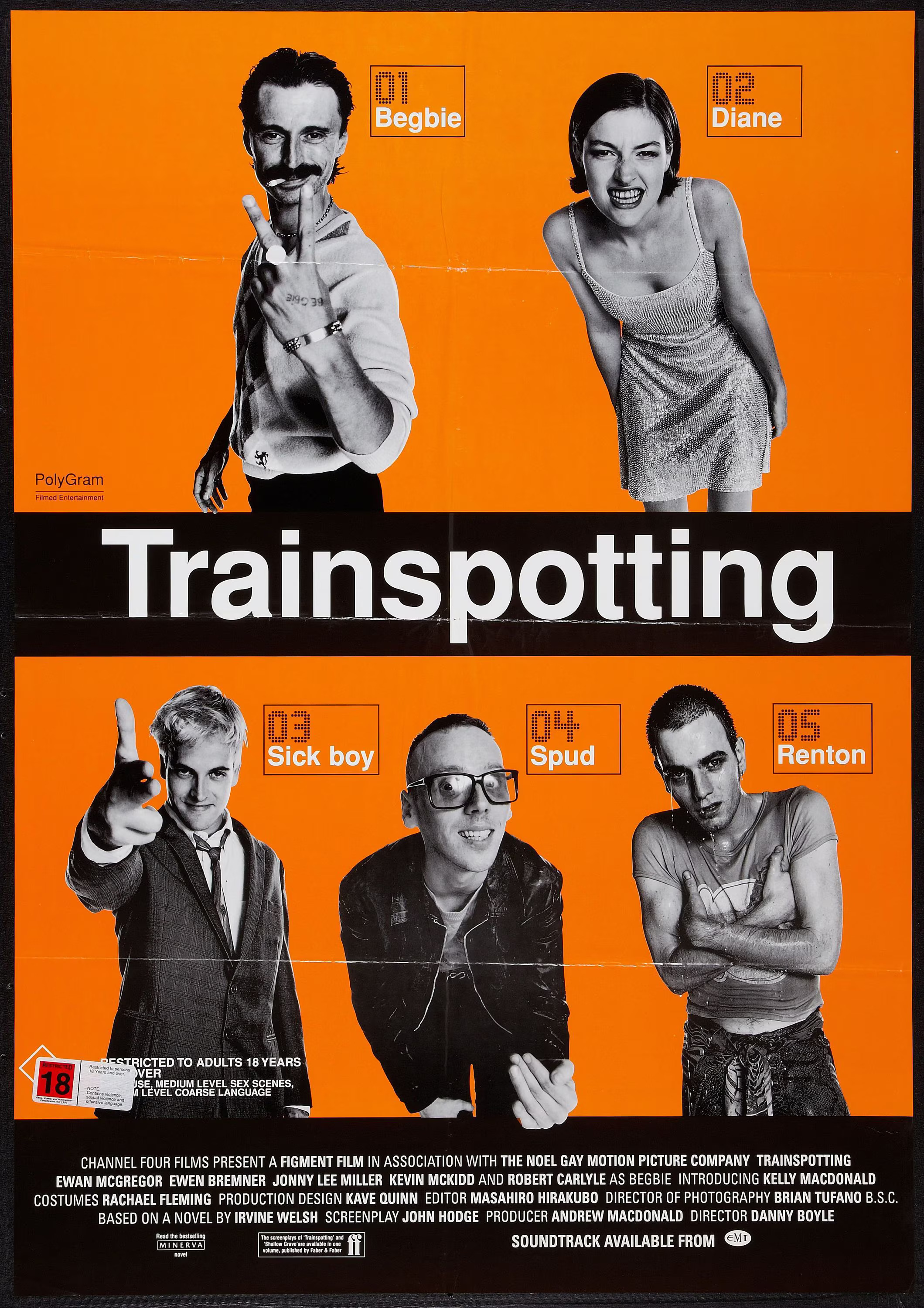
Looking up Trainspotting you’ll see a collection of incredibly positive and praise-filled reviews, describing the film as a brutal and darkly comedic 90s time capsule. While this is all true for me, it hurts the film’s overall enjoyment. I may be in the minority here, but I’d love to explore why for myself, and some others Trainspotting is a film that we appreciate from a distance and why as stated in our podcast I much prefer its legacy sequel.

A Disgusting and Thick Atmosphere
The setting now stands as a brilliant time capsule of the time when Scotland was in the grips of a horrific epidemic that it is still facing today. The film gives us an intimate and close view of the daily lives of several habitual users and one career criminal in their hometown.
Danny Boyle is a true visionary there is no debating that and even in one of his earlier theatrical releases his incredible direction and unique style are clear. Trainspotting is one of the ickiest and gross feeling films I’ve ever seen. Despite being more restrained than other infamous films there is something so unclean about this film. The decrepit and rundown buildings across the streets of Leith are cold and uninviting making you want to be anywhere but there, in one of the more gag-inducing scenes of the film we are greeted with ‘the worst toilet in Scotland’ that is one of the better examples of the film being gross whilst still making you laugh.
Danny Boyle is a true visionary there is no debating that and even in one of his earlier theatrical releases his incredible direction and unique style are clear.
Trainspotting also makes a habit of using dilapidated buildings to represent anywhere that the disease of heroin has infected. For example, the rundown building that Renton and his friends use or how Tommy’s once clean and homely flat becomes a disgusting rundown pit when he is reduced to an addicted shut-in. This isn’t to say that those not using in the film live in mansions it’s more a case of depicting how the drug is like a festering infection decaying everything around it with the addicted at the centre. The character of Tommy perfectly illustrates this.
While the movie never made any direct statements about the cause of said infection, it’s clear from some of the imagery in the film that poverty undoubtedly has a part to play in the sickness plaguing our characters. But further to this it’s also possible that heroin use is a philosophical choice by our characters the famous ‘Choose Life’ monologue at the beginning alludes to Renton’s lack of direction “I chose not to choose life and the reasons? There are no reasons.” By only giving you a small, nuanced window into these characters it makes their predicament teeter between sympathetic and slightly apathetic.
The film never takes you out of this oppressive and unclean atmosphere whether it’s the graphic scenes of heroin usage or the rough rundown pubs and nightclubs our characters often find themselves in, and despite all this, the atmosphere is one of the film’s biggest draws. I should mention that a grim atmosphere does not always harm a film for me, one of my favourite films of this year is the grim and depressing Dead Man’s Shoes which I adore. However, what made that film really connect with me was that there was some good in the protagonist, an understandable motivation and a somewhat heartfelt core to the film.
A Spectrum of Awful People
Almost every character in Trainspotting is morally compromised often with drug use being the lightest of their offences, take Renton (Ewan McGregor) who is our protagonist, despite this he often does reprehensible things be it the unintentional statutory rape of Diane or him giving his vulnerable friend Tommy his first hit despite knowing what the drug will do to him. None of the characters are likeable in the traditional sense they are more so likeable because they are believable and honest in how flawed they are. The only character really lacking in nuance is Bigby (Robert Carlisle) who is practically villainous in his cruelty and violence. Usually, his purpose feels as though it’s to add tension as well as show that the addicts are not the most despicable characters in this world.
For some, this will really work and it’s certainly a breath of fresh air to see characters that may very well be villains in other films used as our protagonists. However, it leads to the film being emotionally exhausting because rarely do these characters ever do anything that can be in any way justified. They often rob or hurt innocent people whilst also pushing drugs and, in one infamous scene, selfishly cause the death of an infant a scene that sticks with you long after the film is over. On the contrary, there are a handful of moments of light throughout the film usually from the naive and slightly idiotic character of Spud who is the nicest of the bunch at least in the sense that there is not one particularly awful thing he does throughout the film and instead his only crime is participation.
Despite Trainspotting’s short length it very quickly becomes draining after the half-hour mark partially due to the film’s general aimlessness which again is not a terrible thing for what it is trying to do but it just does not click with me. The only consistent plotline we get throughout the runtime is the degradation of the 4 characters’ relationships, with the eventual explosion being the climax of the film with Renton deciding to rob his friends of the profits from their first major drug deal with the ending being a sigh of relief as Renton walks off into the sunrise finally pulling you out of its disgusting depths.
Amazing Style
Where I find myself agreeing with the overwhelming praise is in discussing the film’s style. Its edits are frantic and fast-paced allowing the film to effortlessly jump from scene to scene never letting you settle or get bored. It also helps you see the events from the perspective of the characters more with stories or events witnessed being shown to you as they are retold and, just like the rest of the film, these scenes are slick and punchy either shocking you or making you laugh.
Of course, we cannot talk about Trainspotting’s style without mentioning some of the fantastic visuals, such as infamous the toilet scene, the horrific image of the long-dead baby or even the nightmarish sequence that follows as Renton reconciles with his guilt. The film’s soundtrack perfectly encapsulates the era and many of the songs juxtapose the on-screen events, Renton overdosing to ‘Just A Perfect Day’ is a highlight, and the opening use of Iggy Pop is very welcome.
Closing Thoughts
All of what I’ve mentioned above is what keeps me from seeing Trainspotting as an instantly rewatchable iconic classic that so many others do. I can acknowledge everything that is ground-breaking and great about this film. The performances are excellent, the characters iconic, the dialogue is poignant yet darkly funny and Danny Boyle shows his legendary eye as a director. Unfortunately, the film’s characters and story just do not gel with me emotionally which is something that was rectified in the phenomenal sequel. Despite these issues, I recommend everyone watch it because I think you’re experience will vary depending on personal preference.
Love film and TV? Why not check us out on Twitter!
If you’d like to listen in on Odhrán and Chris’ weekly podcast diving deep into varying films and TV shows check out Monday Movie Madness.
Movie Madness
By Odhrán Johnson & Chris Clawson
 Movie Madness